

Uranus
Author: Thibault Merle
Type : Icy giant planet
Rotation period : 17 h
Revolution period : 84 Earth years
Orbit : 7th planet from the Sun (2.87 10⁷ km or 19.2 Astronomical Units; 1AU= Sun-Earth distance)
Radius: 25000 km (4 Earth radii )
Surface gravity : a 50 kg person feels like they weigh about 45 kg
Main composition : hydrogen, helium, ammonia, methane and water ice
Notable moons : Miranda, Ariel, Umbriel, Titania and Oberon
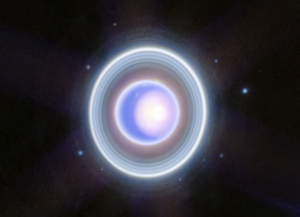
Crédits: NASA, ESA, CSA, STScI
Uranus is the coldest planet in the Solar System. Together with Neptune, they form a category of giant planets known as “ice” or “icy”, due to the presence of ammonia, methane and water ices. Uranus is located more than 19 Astronomical Units (1 AU = distance Sun-Earth) from the Sun, and takes 84 years to complete its orbit! Like other giant planets, Uranus has a system of 13 rings and 27 known moons.
Although there is no defined solid surface inside Uranus (it’s called a phase transition), the outermost part of Uranus’ gaseous envelope is called its atmosphere. The climate here is extreme, with winds of up to 900 km/h and the presence of a few bright clouds and dark spots. It’s also in the upper atmosphere that temperatures break Solar System records: -224°C!
Historical background
Five planets visible to the naked eye have been known since antiquity (Mercury, Venus, Mars, Jupiter and Saturn). Although Uranus is also visible to the naked eye, it was the first planet discovered through a telescope by William Herschel in 1781. Its name comes from Ouranos, deity personifying the starry night sky, father of Chronos (Saturn) and grandfather of Zeus (Jupiter).
The only space mission to have flown close to Uranus was Voyager 2. Launched by NASA in 1977, Voyager 2 performed a close flyby of Uranus in 1986. This mission provided the first detailed images of the planet, its rings and moons, offering invaluable information about this ice giant. Voyager 2 remains to this day the only probe to have visited Uranus up close. Only terrestrial telescopes, and space telescopes such as Hubble and James Webb, allow us to observe it. That said, NASA is seriously considering a new space mission to study Uranus over the next decade.
Interesting stories and fun facts
- The coldest planet in the Solar System. The core of Uranus has almost twice the density of the Earth’s core. Its core temperature of 4700°C is the lowest of the four giant planets. By comparison, the cores of Jupiter, Saturn and Neptune have temperatures of 24,000, 11,700 and 8,000°C respectively. Uranus’ core temperature and distance from the Sun make it the coldest planet in the Solar System.
- Its orbital period is equivalent to the life expectancy of Belgian women. Because of its distance from the Sun, Uranus orbits the Sun in 84 years, which corresponds to the life expectancy of Belgian women in 2018, compared with 79 years for Belgian men. This means that Uranus spends an average of 7 years in each constellation of the zodiac. She is currently in the constellation Taurus.
- A planet that “rolls” in its orbit / A planet that “lies down”. Uranus is the only planet in our Solar System, along with Venus, to be so inclined to the plane of its orbit, the plane in which it orbits the Sun. In fact, Uranus’ axis of rotation is tilted by 98° in relation to its orbital plane, which means that each pole spends a summer and a winter of around twenty years each! This extreme inclination is probably due to one or more massive collisions with other celestial bodies during the formation of the Solar System.
- A planet that smells like rotten eggs. Recent observations from Earth have confirmed the presence of hydrogen sulfide (H₂S) in the atmosphere of Uranus. This chemical substance is responsible for the characteristic smell of rotten eggs. Spectroscopic analyses of the light reflected by the planet revealed the presence of this molecule in the clouds of Uranus.
(Giant ice planets like Uranus and Neptune would plausibly be the most numerous planets in the Milky Way).