

Neptune: The (not so) latest arrival
- Type :Icy giant planet
- Rotation period : ~16 h
- Revolution period :~165 Earth years
- Orbit : 8th planet from the Sun (farthest: approx. 4.5 billion km or 30 Astronomical Units; 1AU : Sun-Earth distance)
- Radius: ~24 622 km (3,9 Earth radii)
- Surface gravity : A 50 kg person feels like he weighs about 57 kg
- Main composition : Hydrogen, helium, methane
- Notable moons : Triton, Proteus, Nereid, Larissa, Galatea
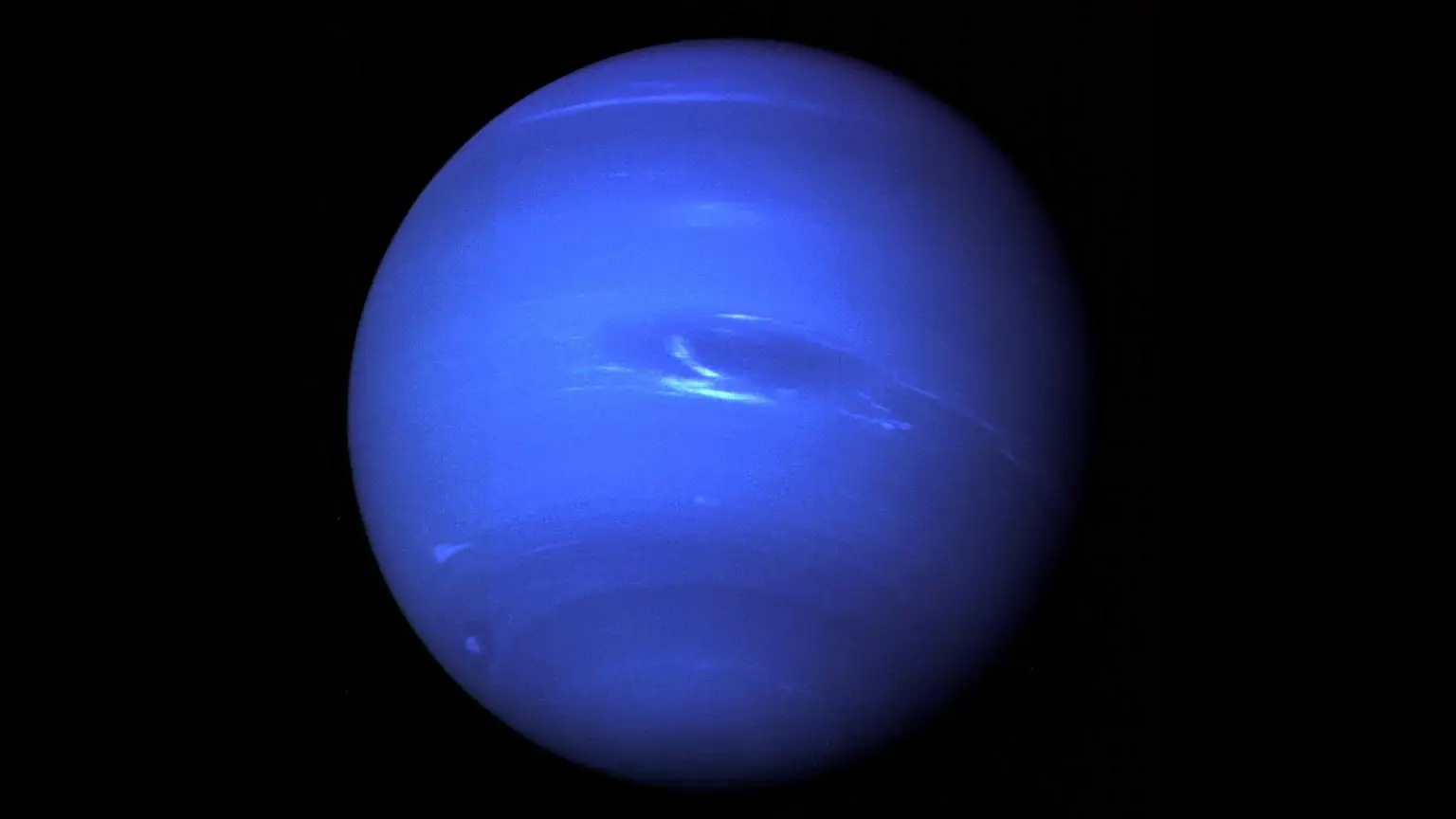
Crédit : NASA (Voyager 2, 1989)
Neptune is the eighth and final planet in the Solar System. It is the furthest planet from the Sun, located some 4.5 billion kilometers away. This ice giant has a radius of around 24,622 km, making it the fourth largest planet in the Solar System. Despite a marked difference in size from Earth, a 50 kg human walking on Neptune would feel barely 7 kg heavier. Its atmosphere is composed mainly of hydrogen, helium and methane, the latter giving it its characteristic blue color.
Neptune has 14 known satellites, the largest of which, Triton, accounts for 99.5% of the total mass orbiting the planet. It also has rings, but unlike Saturn’s, which are very bright, Neptune’s rings are very dark and difficult to detect from Earth.
A brief history of its discovery
Unlike the other planets visible to the naked eye, Neptune was discovered using Newtonian mechanics. In the 19th century, French astronomer Urbain Le Verrier noticed disturbances in the orbit of Uranus. He suggested that these trajectory deviations were due to the gravitational influence of another, as yet unknown planet. In 1846, Johann Galle observed a new planet, Neptune, at the location predicted by Le Verrier, confirming its existence.
Interesting facts
- Extreme winds: Neptune is known for having the most violent winds in the Solar System, reaching speeds of 2,100 km/h. These winds sweep through its atmosphere, creating immense storms, such as the Great Dark Spot observed by the Voyager 2 probe in 1989.
- A Fast Day, An Eternal Year: Neptune completes a full rotation on itself in just 16 hours, but takes around 165 Earth years to circle the Sun. Since its discovery in 1846, it has only completed one orbit, in 2011!
- Triton, a Unique Satellite: Triton is the only large satellite in the Solar System to have a retrograde orbit, i.e. it rotates in the opposite direction to Neptune’s rotation. This suggests that it was captured by Neptune rather than formed with it.
- A Planet Still Mysterious: Neptune is one of the least explored planets. Only the Voyager 2 probe got close to it in 1989. Since then, no mission has been sent to study it more closely, leaving many mysteries still to be discovered.